Pages

Thursday, October 23, 2008

The largest citrus fruit in the world!


The pomelo is the largest citrus fruit in the world. No wonder
it's called the Citrus Maxima. A native of south-east Asia, it
is believed to be the ancestor of the grapefruit. The size can
grow to 12" in diametre.

The fruit is pale green or yellow, depending on the variety. The
rind is thick but soft and spongy. The segmented flesh is either
white or pink. Even the pink varies, it may be dark or light. Some
can be slightly sour but this one in the photo was sweet.

Time for a snack! Salads and juice must be the most popular ways of
using pomelos but my favourite is to add some salt, sugar, chopped
green chillies and a mint garnish. Yummy!!

Sunday, October 19, 2008

My Miniature Plants


The "Painted Net Leaf" or Fittonia has other synonyms too. Also
known as the Nerve Plant or Mosaic Plant, it belongs to the
Acantaceae family. Originally from South American tropical
rain forests it is a moisture-loving plant. It comes in other
colours also but mine is white-veined. The stems are fuzzy.
Propagation is by the stems, broken off and planted.

I've never been good with fittonias although I've grown them,
or in this case, I have to say, tried to grow them for years.
But they would wilt and wither, and eventually die.

About two months ago, in frustration, I pulled it from the pot
and dumped it unceremoniously on a heap of rotting tea-leaves.
Then I forgot about it....One fine day I noticed a rejuvenated
green on the leaves. Even the white lines looked more prominent.
I knew I could no longer ignore or leave the plant like that. Now
it thrives in its new home, tea leaves and all. The pot sits in
partial shade and I water it everyday. And if it gets too hot,
I spray the leaves. They're happy and that shows!!

The Portulaca Grandiflora or Moss Rose. Here it is commonly known
as the 9o'clock flower.

This is a multi-branched sun-loving plant with thick fleshy leaves.
It grows to a height of 15 to 20 cms and spreads to 12 to 14 inches.
Its origin is the hot dry plains of Brazil, Uruguay and northern
Argentina. The best part about the portulaca is that it's very
easy to grow through seeds or by breaking off the stems. Although
a well-drained soil works wonders they're also not averse to the
idea of thriving in poor soil or gravelly and sandy areas. The
blooms open in the morning but by 3o'clock in the afternoon it's
time to call it a day!

Uh-oh! The sign reads---WE'RE CLOSED FOR THE DAY. WE OPEN
AT 9O'CLOCK EVERY MORNING

Friday, October 17, 2008

Gourd Growth----Squashed!


Thinking that this area would be heavily gourded by now I
went to check it out. Instead, what do I see? No green
leaves, stem or tendrils clinging on the wire but dry
leaves; browned, shrunk and shrivelled by an unforgiving,
relentless sun...you could almost sense the crackle of
leaves---as dry as loofahs that's never been used!

Severed from The Main Stem it will only be a matter of
time before any signs of a vine ever being here will
remain...

From now on it looks like the vine is going to be within
the confines of a certain space. Better sense has prevailed,
after all.

Tuesday, October 14, 2008

No Wire Too High


Wires, electrical or otherwise, have a lot of activity on them. And
with so many birds flocking to these perches, dull moments are few
and far between! It's time for a little romance for these love-birds...

whereas for these two, time spent on the most happening perch is in---
companionable silence.

belligerent?

Taking a breather...

contemplating the instant future?!

tragic, an electrocuted bat...I happened to see it from the car,
stopped and took this shot. I've never seen anything like this
before.

What can I say about this, except GO(ourd) FOR IT!!!!!

Monday, October 13, 2008

Blue Butterfly Pea and Red Bleeding Heart


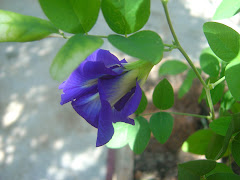
I was greeted by this vivid blue yesterday. My butterfly pea's
first bloom! It's the double-petalled variety and almost rose-
like in appearance. In the single variety, the white in the middle
of the flower is easily seen but here, you can't make out.
This plant belongs to the pea family. The colour of the blooms
may range from purple, lavender, white and deep blue.

A native of sub-tropical America and India, it can grow up to
9ft in length. It looks nice trellised. The seeds are produced
like peas.


This plant is less spectacular in appearance than its white and
red cousin. Although it is known as Red Bleeding Heart it's more
pink than red. But against those dark green leaves, the pink
clusters certainly cannot be ignored!

Saturday, October 11, 2008

Baby Pigeon Update


These photos were taken over the past few days. Baby's fine,
doing well and growing fast. It sensed D for danger everytime
I climbed a rickety table to get a closer look. I was wrong in
thinking it'd go "cheep-cheep" (an overdose of bird cartoons in
my younger days!!) because the only sound it made came from
opening and shutting its beak. Although I took great care not
to scare it, it was annoyed. I was, after all, an alien.

All puffed up as I went nearer for this shot.


I didn't see the mother near the nest when I went to the shed
but she was in the vicinity, either on the wire or on a tree,
and that was a heartening sight.

These might also turn out to be the last pictures. Look at the
feathers! Isn't she beautiful? And beginning to look like the
mother too! She even raised one feather when I went too close.
She could well be on her maiden flight in a day or two. And I
also found out that a fledgeling pigeon is called a squab. I
wasn't aware about this earlier.

I thought the beak looked too long for such a tiny body but
a few days' growth has changed all that. Here's to a fine
little bird....may you never run out of worms, nuts, leaves,
bugs and berries. And if you're a 'she' as I'd like to believe,
may you come here when it's time for you, to nest and brood...

Friday, October 10, 2008

A Different Kind Of Spinach


The very prolific Racquel--Perennial Garden Lover--had a
post titled Seedhead and Berries on Oct.9. Reading that
interesting post, I thought about this particular plant.
The seedhead does look a little strange and some are almost
grotesque in shape.
There are several names for this plant; Malabar spinach, Ceylon
spinach, Vietnamese spinach, Slippery vegetable and Vine spinach.
It does taste like spinach but it has a mild flavour. Whereas
spinach is smooth in texture when cooked, this one becomes slimy
if over-cooked. This is because of a thick gluey substance rather
like okra, so care must be taken not to cook it for long.

Said to be originally from India, it is found all across south-
Asia and Africa. The botanical name is Basella alba or Basella
rubra. The B. alba is the light green variety whereas the
purplish-stemmed ones are B. rubra. I have the latter, but it
is slightly different from the ones you might see on certain
web pages. The leaves and stems are smaller and the leaves are
not thick.
In our area, the smaller type grows like weeds, which is why I
could separate the various stages of seeds for the photos. I
treat them like weeds too, uprooting them as they spring up
even in pots, ready to twine and choke the plant the pot was
intended for!


I remember reading in someone's blog ( I can't remember the name)
that one should never be happy about really fast-growing plants
as they tend to be invasive. How true about the basella!
Propagation is by seeds and stems. Cuttings do not take long
take root. A very easy to grow plant indeed!

This soft-stemmed vine tolerates high rainfall and humidity. Even
if the soil is fairly poor, it'll still do well.
Like any other leafy green vegetable, it is high in vitamin A, C,
iron and calcium. LIke berries, the ripe seeds yield a rich purplish-
red colour when crushed. The dye is used for official seals, rouge,
and even food colour. The colour is enhanced by adding lemon juice.

The last photo is a mixed vegetable I cooked. It has bits of
pumpkin, potatoes and basella. Here I've added only the leaves
but tender stems are consumed too. I like to have the stems in
mustard sauce. We also add the finely chopped leaves to fish curry.